Sunday, April 22, 2007

The dimise of the public intellectual.

Who now writes for the educated reader? Twenty years ago Russell Jacoby asked this question and warned of the dangers of the the missing generation of intellectuals who had influence in the public mind. The fact that in 1987 there seemed to be an absence of public intellectuals, compared to the previous century or so, inspired him to write The Last Intellectuals: American Culture in the Age of Academe. Jacoby noticed that by the late 1980s a new generation (the youth of the 60s) had not penetrated the public mind in the way that Vidal, Mailer, and others had in the late forties and early fifties, and he tried to find out why. Now, twenty years later, while Vidal and Mailer—perhaps the last of the breed—continue to be recycled and we are seeing an interesting trend and a new answer to the question posed 20 years ago by Jacoby.

But in 1987 the atmosphere was a bit different. Jacoby believed that the sixties, youth had been co-opted by academia, whose structural conditions had the effect of modifying the content of their output in such a way that it was of little interest to the general public: those who had once written for the educated public, were now writing for fellow academicians; by changing the target audience, the power of the new generation of intellectuals to affect the public mind was reduced.

I would argue also that its substance was now left to be filtered though the lens of the polemicists who had, by the early 1990s, replaced them in the public sphere—more about this in a moment.

As in the physics of a closed system, heat is drawn from the thing . . . the energy they devoted to the radical causes of the 1960s was transferred to the university system.

While he did not totally discount the contribution of journalists et. al., he believed that content, too, was modified by the institutional presence of "deadlines, space, [and] money" (Jacoby 13) seemed to alter any meaningful contributions they might produce. In references to Noam Chomsky's "Propaganda Model," one might also add the modifying effect of the advertisers in a private media setting. All of this served to change the public discourse and to make the environment less friendly to the public intellectual.

Twenty years later, the question is again asked, who now writes for the educated reader? Not surprisingly it is the person who communicates primarily through electronic means, who does not require his audience to read at all; he is a radio star, a television "talking head." It is this entity that has taken the place in public debates that was once the pervue of the public intellectual.

Sunday, April 1, 2007

Flag Desecration

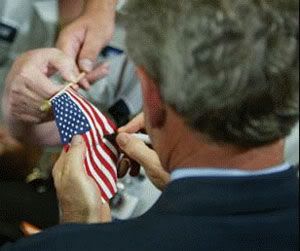
This is illegal:

Photo Sharing and Video Hosting at Photobucket

Photo Sharing and Video Hosting at Photobucket

Executive Order. US Code Section 7(b) "The flag should not be draped over the hood, top, sides, or back of a vehicle or of a railroad train or a boat. When the flag is displayed on a motorcar, the staff shall be fixed firmly to the chassis or clamped to the right fender." 4USC7
AND. . .
i) The flag should never be used for advertising purposes in any manner whatsoever. . . .(j) No part of the flag should ever be used as a costume or athletic uniform." 4USC8

. . .One may sign it, salute it, or burn it; but it may be
that the only difference is what is in his mind.

The defender of the Home Land:

Photo Sharing and Video Hosting at Photobucket

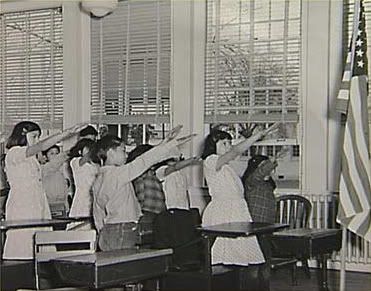
West Virginia Children forced to salute with a "stiff" arm. This case went to the Supreme Court in 1942:

Photo Sharing and Video Hosting at Photobucket

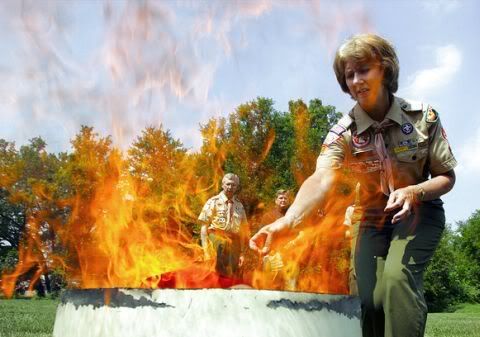
"Retiring" an American flag:

Photo Sharing and Video Hosting at Photobucket

The whole issue is a double standard, and what people want to outlaw is what is in the mind of the person who does it. That's what makes the anti-flagburning position all the more indefensible. Most criminals are defined by their actions; the "flag burner" who is the target of ant-flag burning legislation, is defined by what he thinks.

Friday, March 23, 2007

On Bossier City Police and the Thugs of the Cosa Nostra

I've been thinking about Charlie Chan lately. He was my first favorite fictional character. I am a great fan of the old Chan movies. Played by several actors over two decades, this character was best portrayed, in my opinion, by the Swedish actor Warner Oland throughout most of the 1930s. A wise polymath, Chan would interact with the public with a modest respect. Before making a point of order, he would invariably begin with the polite interjection, "Excuse, please—but...." What followed was a hard-hitting, logical, and necessary point. Chan did not waste words.

Yesterday one of my students, a pregnant woman in her twenties, was visited by a Bossier City, La. Police detective named Thomerson. The highlights: She was met in the main (public) reception area by a man of Asian decent who wore a badge and gun. I, and several others, were present in the area. She was told that she was not under arrest, but that she was to come with him to another jurisdiction to answer questions. She was not under arrest, but, he insisted, she had little choice but to come with him. She politely refused, but offered to meet with him after class to speak. He agreed to this but continued to brow-beat and threaten her with arrest if she did not come at the agreed upon time.

After agreeing to meet with her later in the day, he began to publicly emote. He raised his voice and took on the body language of a professional wrestler. He told various people in the vicinity that she was "stalling" him. His tone was aggressive and confrontational. "I do this for a living, I know when I'm being stalled!" The student who was on her way back to class, stopped and turned around.

"I'm w-what?" She asked in apparent confusion. At this point some ten feet away from the officer, and he moved toward her with determination. I was standing between the two of them. He stopped when he got near me and snapped at me, "get out of my face!" Given the fact that he had walked up to me, I felt that this was an un-reasonable demand. In the meantime, the student went back to class while the officer continued to emote.

In her absence he fretted that he was going to "look like an idiot," if she didn't meet him at four o'clock. He asked petulant questions, harangued those of us still present, caused a scene, and then left.

I stood amazed by what had just happened, and I thought about Charlie Chan. Like many Americans I derive at least some of my moral standards from the "movies," and it was from the iconic Asian-Hawaiian detective that I had first learned to respect the cops. Considering the positive signification of Asian policemen in my mind, the experience was particularly jarring. Never had my childhood hero browbeat and intimidated a pregnant woman; never had I seen him stand in a public hallway griping about the motives of a potential witness; and never had the venerable Chan complained that he would look like an idiot if a person of interest didn't show up for questioning.

But if such behavior is unacceptable in an average person, it is beyond contempt in a public servant. This point has a practical as well as moral dimension to it: it is understood by anyone who interacts with a person who is armed with a handgun that there is an unstated, but ever present, power differential. The person with the gun has an enormous amount of influence. That the armed person is a police officer does little to comfort the citizen who must deal with him. A policeman who walks up to a teacher who has only a red pen in his pocket, and tells him to, "Get out of my face!" is not only engaging in appalling behavior, he is also chipping away at the remaining veneer of respect and trust that we all want to have for our constabulary.

The recent decades have shown that law enforcement is not always the highly moral protectors of safety and service that they champion themselves to be. In fact, no longer are the police assumed to be virtuous. Recent examples of police and persecutory criminal activity continue to confirm this unpleasant fact. Several years ago, Alex Kozinski, a conservative judge on the 9th Circuit Appellate Court, stated that the fact of police perjury is, "an open secret long shared by prosecutors, defense attorneys and judges." In Los Angeles last year, the ugly details of the Ramparts precinct drug division became a matter of public record. These details included the theft of drugs by police officers as well as the "planting" of drugs on suspects. In one case, members of the unit planted a gun on a man they had shot and who remains paralyzed by the attack. Similar examples of police misconduct were reported by New York's Mollen Commission which stated, "The practice of police falsification in connection with such arrests is so common in certain precincts that it has spawned its own word: "testilying"
(http://www.constitution.org/lrev/dershowitz_test_981201.htm#N_10_> House of Representatives Judiciary Committee ). University of Florida Law professor, Christopher Slobogin, has recently produced an extensive survey of law enforcement perjury which indicate that such practices are endemic. From a moral point of view, a significant number of law enforcement personnel appear virtually indistinguishable from the thugs of the Cosa Nostra.

When the police help, we like the police. When they bully and bluster, which is too often the case today, we reasonably look for ways to protect ourselves. A policeman's job is hard, and it is supposed to be. In 1958's A Touch of Evil, Charlton Heston famously quipped, "A policeman's job is only easy in a police state." Indeed, unless we wish to pass on to the future a culture of Brown-Shirt authoritarianism, we should resist the idea of the moral exceptionalism of the police.


Sunday, January 7, 2007

Reflections on My Pacific Island Childhood.

Will I tell you that when I was a boy, there was time?
When I was a boy, I had time and I did not know that time was precious; I would loaf by the trees and eat my bologna sandwich, and fall asleep in the warmth of the sun. And when I awoke, there was time. I did not realize that it was hurrying past me. I lived in the hub of its wheel where I neither lost nor gained time, but I was still. And time was still with me and I was with time. And I was happy.

At dusk, I would carefully make a fire. The fire would warm me, and then I would go home. I would pass the pearl divers' huts and I envied their freedom. For a time I would linger by the pearl divers' huts and smoke papaya bark, and consider the undulating sea, until my mind burned with clarity.

Then, I walked on until I saw the smoking chimneys of my street, the smell of wet stone and burning wood and stale farts. The delight on my mother's face, the letter in her hand from my father, who had gone to Sydney for work, the pie she had baked. A time, lived in its own time, never guessing that it would one day be a memory.

Thursday, December 28, 2006

A Friend's Grace is like a Well.

A thousand times have you muddied the waters with your broken oar,
Though you knew the waters of friendship were clean and sweet,
Once given your cup, you sloshed your precious dram upon the floor
Thinking that to fill your friendship cup again was no great feat
But when the cup was empty, the well gave you no succor
Then, you sorely cursed the well, and cried into your sheets

Said you saw more than others; Shaman-like, your vision burned
But I knew you saw the future through mild hallucinations
I shall not pass again, and will on this road now sadly turn
You thought your vision was no more than an apotheosis
Was it all so clear to you, this homespun, back-woods divination?
You saw what was not there, and will suffer your own mind's spurn.

The Economy, Some Thoughts.

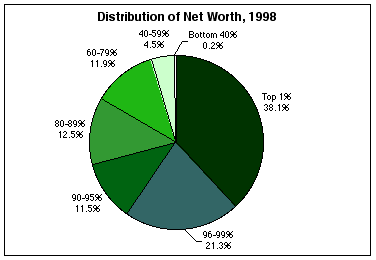
If recent poles are to be believed, the level of tolerance that contemporary Americans show for economic inequality is relatively high. Perhaps because it is now less understood that Americas economic model is not the most successful on earth. According the The Economist,

“Over 70% of Americans support the abolition of the estate tax (inheritance tax), even though only one household in 100 pays it. Americans tend to blame their woes not on rich compatriots but on poor foreigners” (Economist).


Photobucket - Video and Image Hosting

This is in spite of the growing gap between rich and poor in the last quarter century, Americans continue to voice faith in the aphorisms of the American Dream as they attempt to “pull themselves up by the bootstraps,” and “make it.”

The construct of the “American Dream” promotes the belief that any person who is willing to work hard and “follow the rules” is almost guaranteed entry into (at the very least) the middle class. But while there is always an element of intention with a person escaping poverty, the statistics show that areas favoring upward mobility are distinguished from those with unfavorable climates. According to the Research on Economic Inequality,

“In the United States almost one-half of the children born to low-income parents become low- income adults. This is an extreme case, but the fraction is also high in the United Kingdom at four in ten, and Canada where about one-third of low-income children do not escape low income in adulthood” (Miles Corak, 2006, 13 (1), 143-188)

And, unless one believes Americans are by nature less thrifty or clever than their Canadian neighbors, it would stand to reason that the economic environment of the U.S. is less conducive to upward mobility. As the Economist put it recently, if one wants to enjoy economic success in America, he must first, "pick the right parents."